

Commentary
Pierre Vimont
{
  "authors": [
    "Pierre Vimont"
  ],
  "type": "commentary",
  "blog": "Strategic Europe",
  "centerAffiliationAll": "",
  "centers": [
    "Carnegie Endowment for International Peace",
    "Carnegie Europe"
  ],
  "englishNewsletterAll": "",
  "nonEnglishNewsletterAll": "",
  "primaryCenter": "Carnegie Europe",
  "programAffiliation": "",
  "programs": [],
  "projects": [],
  "regions": [
    "Europe",
    "Ukraine",
    "United States",
    "Russia"
  ],
  "topics": [
    "EU",
    "Foreign Policy",
    "Security"
  ]
}
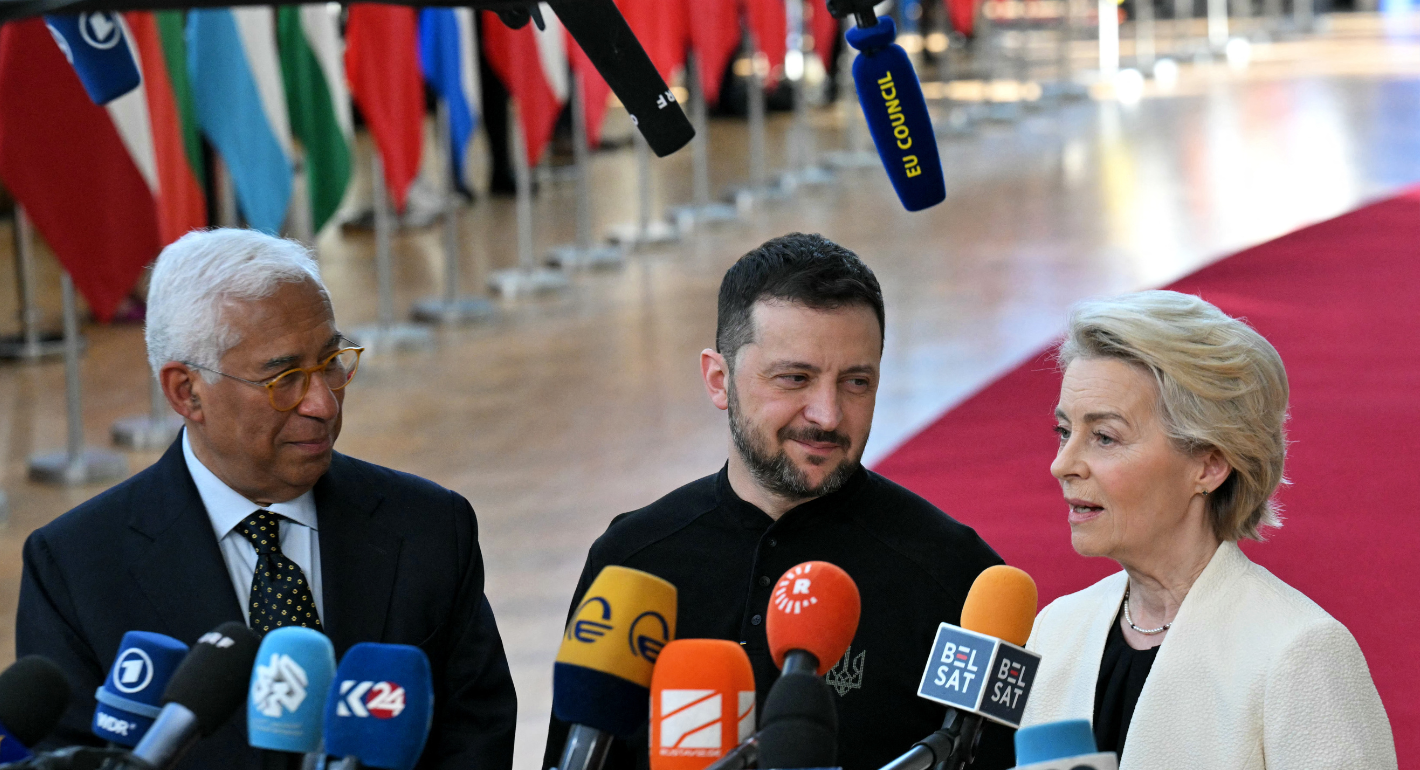
Source: Getty
Sidelined by the latest U.S. initiative on Ukraine, Europe has no alternative but to set out its own strategic vision—not just for Kyiv but for the entire security order of the continent.
The second administration of U.S. President Donald Trump has made 2025 a rollercoaster ride for the EU, with Brussels trying to keep up with a steady flow of destabilizing initiatives from Washington. Each fresh diplomatic drama surrounding the war in Ukraine—from a shouting match in the Oval Office, to the Alaska summit between Trump and Russian President Vladimir Putin, to the so-called twenty-eight-point peace plan and its successors—has left Europe improvising its damage limitation with varying levels of success.
Rather than remaining sidelined and stuck in crisis management mode, it is time for Brussels to come up with its own considered strategic response. It should be no less than a European vision for the whole continent that sets out its own plans for security, as well as the parts that the EU, NATO, the United States, Ukraine, and Russia should play in a future order.
The winds are not favorable for Ukraine and Europe, as the latest push for peace has only made the situation worse for both their interests. The Trump administration chose to publish their proposal just as Kyiv and European allies faced new setbacks. The Ukrainian army is struggling to regain the military initiative in the Donetsk region and the country’s leadership has been hit by new corruption scandals. Meanwhile, despite protracted discussions, the EU has been unable to finalize plans for a reparation loan to Ukraine backed by Russian frozen assets. All of this takes place in a context where the Russian economy has stayed more resilient than expected in the face of unprecedented sanctions.
The combination of these adverse events must not overshadow the significant difficulties Russia is also experiencing. Yet the U.S. plan stirs a new sense of urgency among Europeans. American negotiators remain convinced that time is on Russia’s side and Ukraine is irreversibly on the back foot. From that point of view, this latest initiative has already changed Europe’s diplomatic parameters. By requiring that Kyiv and its allies consider the stark necessity of political compromises and painful concessions, this peace plan is a dire reminder of a hard reality.
Naturally, the final outcome of the negotiations is far from certain. Though talks could quickly come to a halt, the Russian government seems intent on keeping the ball rolling to avoid a breakdown in its relations with the United States. If negotiations move ahead, they will almost certainly not meet all the political goals Kyiv and Brussels have openly advocated for, because of unbalanced American brokering. These talks may well simply break down, but the risk then would be of losing both Washington’s diplomatic efforts and its remaining support to Ukraine.
Both options back the EU into a corner. As it is unable to significantly increase its overall financial and military support to Ukraine, Brussels cannot expect the situation on the battlefield to change much. With Russian troops maintaining their slow advance, there is little hope of U.S. negotiators easing their current pressure on Kyiv or coercing Moscow into major concessions.
For Europe, therefore, this is a time of reckoning. To escape these difficulties, leaders must kickstart a revamped and more agile diplomacy. They can only achieve this by engaging in the discussions they have avoided for too long: on a possible European peace plan for Ukraine, and on a new vision of a future security order for the continent. Such a debate will inevitably expose deep divergences among union members on issues where the legacies of history and geography have forged natural differences among them. But moving out of this prolonged strategic silence is imperative, if only to regain the initiative and be perceived as a relevant player.
This strategic input must help bridge the gap between the focus of U.S. negotiators on quickly delivering a peace settlement and the European focus on brokering a long-term outcome that opens the way to a sustainable security order. Such vision demands a clear understanding of the security guarantees required for Ukraine, the positioning and role of NATO in a postwar context, the responsibilities of a future European defense union, and the kind of contacts the EU needs to progressively build with Russia in order to define new rules for a likely unstable future coexistence. Unavoidable compromises and mutual concessions will have to be made on issues like territorial recognition, NATO accession for Ukraine, or security guarantees. Likewise, these will have to be reconciled with long-term considerations to preserve core principles adopted when the Soviet Union fell.
The EU has enough leverage to achieve some genuine agency in negotiations. Be it sanctions, Russian frozen assets, security guarantees, or accession to the EU, Brussels has the cards to drive a nimble diplomacy that acts in close tandem with Ukraine. Such agility will advocate for innovative ideas and introduce an additional negotiation track dedicated to specific, long-term discussions on a revisited European security framework.
For a very long time, Europeans have preferred to avoid uncomfortable strategic debates because they knew any such discussion would reveal inherent divisions among union members—particularly when considering possible engagement with Russia. Yet this attitude has brought twenty years of strategic carelessness that must now be recouped. It is high time for the EU to confront the reality check imposed by the present negotiations and start its own strategic conversation.

Senior Fellow, Carnegie Europe
Pierre Vimont is a senior fellow at Carnegie Europe. His research focuses on the European Neighborhood Policy, transatlantic relations, and French foreign policy.
Recent Work
Pierre Vimont
Pierre Vimont
Carnegie does not take institutional positions on public policy issues; the views represented herein are those of the author(s) and do not necessarily reflect the views of Carnegie, its staff, or its trustees.
The EU is putting together a new security strategy to meet today’s myriad challenges. But for any proposal to be effective, the union needs to grapple with its identity and ambitions.
Pierre Vimont

The EU’s new migration policy is not suited to today’s realities. With climate change increasingly becoming a driver of displacement, Europe needs to rethink its deterrence-focused approach.

Shana Tabak
The battle over free speech has taken center stage since U.S. Vice President JD Vance accused Europe of censorship. From travel bans to social media regulation, especially around the Israel-Palestine conflict, are liberal democratic governments weaponizing free speech?

Rym Momtaz, ed.
Europe seems to have accepted its sidelining in the Middle East. The EU must reassert its support for the international rules-based order and step up engagement.
Rym Momtaz

Amid uncertainty caused by the Iran war, the global drive for nonproliferation has stalled. With Europe diplomatically marginalized and countries reassessing their nuclear options, efforts to curb the spread of nuclear weapons risk becoming irrelevant.

Jane Darby Menton