

Commentary
Katherine Wilkens
{
  "authors": [
    "Katherine Wilkens"
  ],
  "type": "commentary",
  "centerAffiliationAll": "dc",
  "centers": [
    "Carnegie Endowment for International Peace"
  ],
  "collections": [
    "Rebuilding Gaza: The Human Dimension",
    "Palestine/Israel Projects"
  ],
  "englishNewsletterAll": "menaTransitions",
  "nonEnglishNewsletterAll": "",
  "primaryCenter": "Carnegie Endowment for International Peace",
  "programAffiliation": "MEP",
  "programs": [
    "Middle East"
  ],
  "projects": [],
  "regions": [
    "Palestine",
    "Middle East",
    "Israel",
    "United States"
  ],
  "topics": [
    "Domestic Politics",
    "Foreign Policy"
  ]
}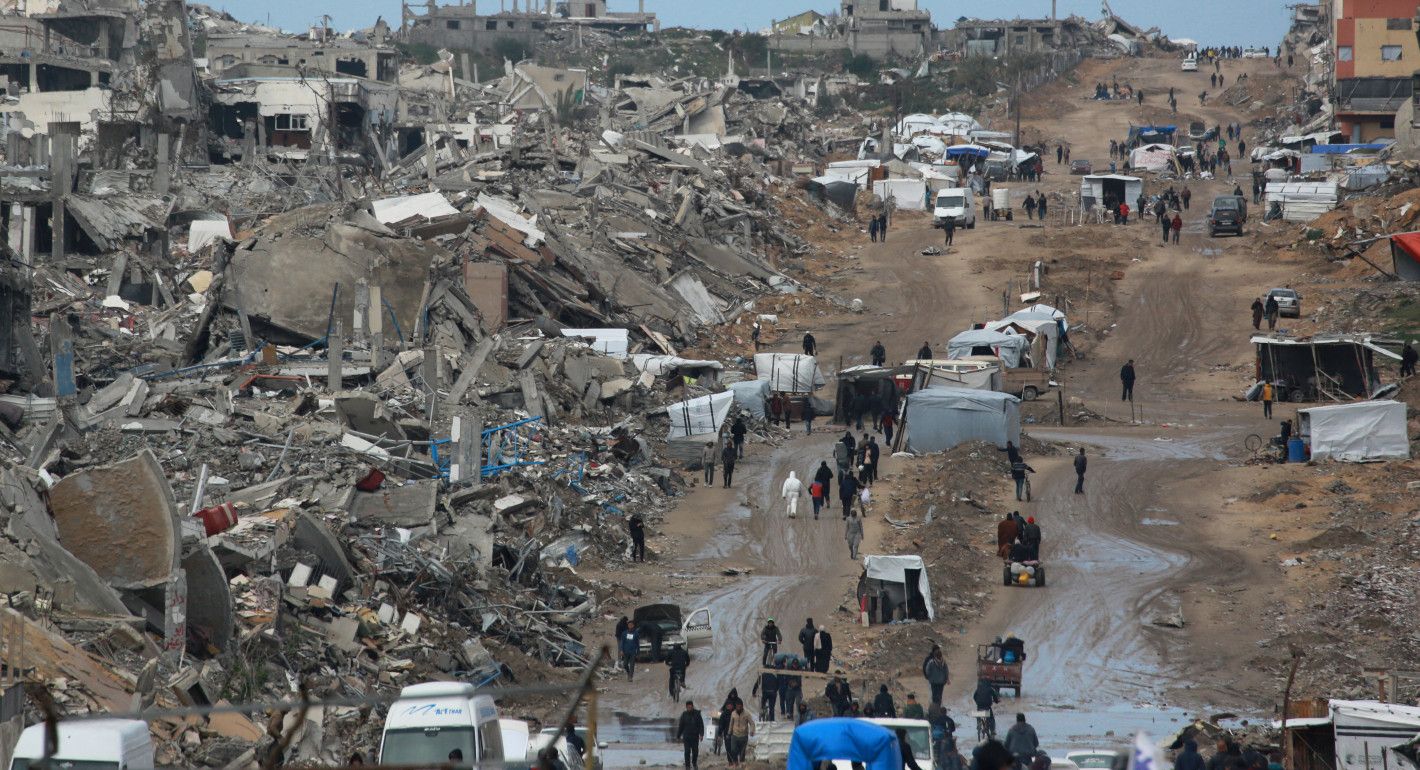
Palestinians walk amid destruction in Jabalia in the northern Gaza Strip on February 6. (Photo by Bashar Taleb/AFP via Getty Images)
Whether Trump will be able to keep his campaign trail promises to end the Israel-Hamas war is an open question.
Despite significant obstacles, the three-phase Israel-Hamas ceasefire agreement has been surprisingly resilient thus far. The numbers of humanitarian convoys permitted to enter Gaza have surged, hostages and prisoners continue to be released, and hundreds of thousands of displaced Palestinians have been permitted to return to their devastated neighborhoods in northern Gaza. Israel is also set to reopen the critical Rafah border crossing between Gaza and Egypt earlier than expected and for the first time since May 2024. Fifty wounded Hamas fighters will exit via the crossing for medical treatment in Egypt, reportedly with assurances they will be able to return following recovery. EU border inspectors, along with local Palestinians, will take over management of Rafah’s Gaza side from Israel. The ceasefire process has demonstrated that actions deemed impossible are possible when key stakeholders are willing to apply leverage to move the process forward.
As the essays in our series on the Gaza ceasefire show, the situation in the war-devastated strip remains desperate. A massive and consistent surge of aid and technical support is required to save lives and restore critical water, electricity, sanitation, and other vital services. Palestinians will be dependent on international donor support for the foreseeable future. With the most child amputees per capita in the world—an estimated 13,455 to 17,550—and tens of thousands more suffering from life-altering injuries, the population will need long-term specialized medical care, rehabilitation, and psychological support. The most severe cases will require the ability to access lifesaving medical services abroad. In the short term, mobile health units and other internationally supported interventions will be necessary to supplement the limited healthcare services at Gaza’s damaged and overstretched hospitals.
Prior to his election, President Donald Trump insisted that he would end the war in Gaza. The days ahead will test that. Since early this year, U.S. Middle East envoy Steven Witkoff has been engaged in ensuring that the first forty-two-day phase of ceasefire in Gaza holds. But phase two of the agreement will likely present a major threat to the durability of Israeli Prime Minister Benjamin Netanyahu’s far-right coalition partners, who have strongly opposed a permanent ceasefire in Gaza. Many believed Netanyahu’s trip to Washington was timed in hopes of receiving a green light from Trump to withdraw from the agreement. If so, that appears for now to have failed.
But in a lengthy White House press conference with Netanyahu on February 4, Trump presented a plan for Gaza that includes relocating the enclave’s 2 million Palestinians to Egypt, Jordan, and other countries in the region, allegedly for the purpose of “cleaning out” the strip and developing it for the benefit of the world. The idea, which evoked painful images for many of the Nakba, the historic 1948 displacement of more than 750,000 Palestinians, could rupture longstanding peace treaties between Israel and two of its closest neighbors.
Trump’s plan—and his previous comments—elicited broad condemnation around the Arab world, including from Saudi Arabia. Thus far, Trump has exempted Jordan and Egypt from the three-month hold his administration placed on all U.S. foreign assistance, but in the current uncertain environment in Washington, how the administration might react to this strong opposition is unclear.
Israel’s left-leaning Haaretz newspaper dubbed Trump’s comments “an imperial tantrum.” Elsewhere in the Israeli press, speculation suggested that the calculation behind the announcement might be to “shake the Arab world into action” and push Israel’s Arab neighbors to do something about the situation in Gaza.
Whatever happens next, it is clear that the price for advancing the ceasefire in Gaza appears to have come at the expense of the West Bank, where the Israel Defense Forces have put up dozens of new checkpoints in recent weeks, severely limiting Palestinian freedom of movement. Attacks by Israeli forces and settlers also have escalated following implementation of the first phase. The Jenin refugee camp was emptied of residents, and homes, infrastructure, and roads were destroyed.
The White House has taken early steps to signal a hands-off policy on the dangerously escalating violence in the West Bank. Trump issued a new executive order reversing sanctions on violent Israeli settlers in the West Bank and placing a ban on U.S. funding for the United Nations Relief and Works Agency for Palestinian Refugees (UNRWA), a key provider of humanitarian aid in Gaza, as well as critical health and educational services to Palestinians in the West Bank and refugees in Arab host countries. On January 30, Israel shuttered UNRWA’s offices in East Jerusalem and made it illegal for Israeli officials to have contact with its staff. Without the ability to coordinate directly with the Israeli military authority over the occupied territories, the future of the UNRWA’s work in Gaza and the West Bank is at serious risk.
The days ahead will reveal whether Trump’s latest Gaza plan is designed to move toward a permanent ceasefire in Gaza or enable another generational mass displacement of Palestinians. The latter will have dire implications for Israel’s relations with its closest neighbors and the broader Muslim world and almost certainly would push the elusive Israel-Saudi normalization deal off the table indefinitely.
After more than fifteen months of war, Israel’s neighbors—and many Israelis themselves—have a strong desire for the fighting to end. Whether Trump will be able to keep his campaign trail promises to make that happen remains to be seen.
Read more from the series:

Nonresident Fellow, Middle East Program
Katherine Wilkens is a nonresident fellow at the Carnegie Endowment for International Peace where she formerly served as deputy director of the Middle East Program.
Recent Work
Katherine Wilkens


Scott Anderson, Jeremy Konyndyk, Ambassador David M. Satterfield, …
Carnegie does not take institutional positions on public policy issues; the views represented herein are those of the author(s) and do not necessarily reflect the views of Carnegie, its staff, or its trustees.
The Islamic Republic’s words and actions suggest that it has changed its approach to both diplomacy and war.
Mohammad Ayatollahi Tabaar
Policy discussion is ignoring that the Palestinian national project is hollowed out and apartheid is a present danger.

Nathan J. Brown
The EU’s new migration policy is not suited to today’s realities. With climate change increasingly becoming a driver of displacement, Europe needs to rethink its deterrence-focused approach.

Shana Tabak
The issue is not that the president only has selective information at his disposal, but that the decision-making process consists of one person with an unshakeable vision of how the world works.

Tatiana Stanovaya
The impacts of the Faye-Sonko rupture could go well beyond the country’s borders.

Lesley Anne Warner